
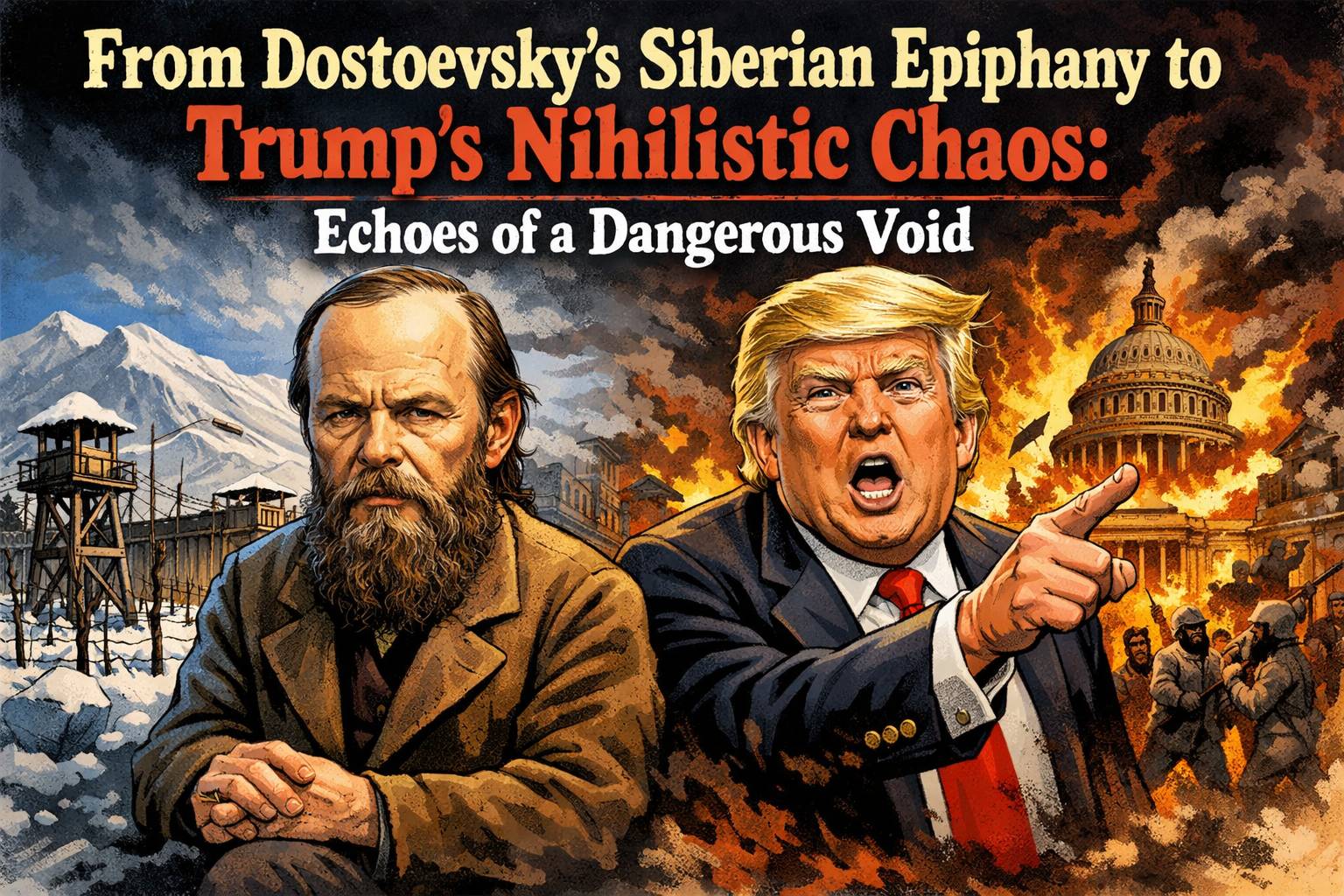
In the annals of intellectual history, few transformations rival Fyodor Dostoevsky’s. Arrested in 1849 as a member of the Petrashevsky Circle—a group of utopian socialists flirting with radical ideas—he faced a mock execution before Tsar Nicholas I commuted his sentence to four years of hard labor in Siberia’s Omsk prison, followed by military service. The young Dostoevsky entered as a fervent idealist, seduced by Western notions of progress and reason. He emerged in 1859 a broken yet reborn man, his worldview shattered and rebuilt through suffering. Central to this metamorphosis was his rejection of nihilism—the seductive philosophy that denies absolute meaning, morality, or truth, reducing existence to arbitrary power plays.
Dostoevsky’s prison notebooks and masterpieces like Notes from a Dead House, Crime and Punishment, and Demons chronicle this reckoning. Nihilism, he witnessed, wasn’t abstract; it devoured souls. Inmates who embraced it—despising all authority, God, and even their own humanity—descended into spiteful isolation or violent despair. “If God does not exist, everything is permitted,” Dostoevsky warned through Ivan Karamazov in The Brothers Karamazov. Siberian hell taught him nihilism’s peril: without transcendent anchors, humans become wolves to one another, rationalizing any atrocity. Russia, he argued, had glimpsed this abyss in its radicals and recoiled, preserving its Orthodox soul through communal faith and tradition.
Fast-forward to March 2026, and the world confronts a spectral echo: Donald J. Trump, reelected U.S. President, whose erratic governance seems to embody this very void. Trump’s worldview—transactional, impulsive, unbound by ideology—mirrors nihilism’s core tenet: nothing is sacred, truth is malleable, power is the sole arbiter. He praises dictators one day, disavows allies the next; tariffs on allies, bromances with adversaries; promises of “America First” that twist into personal vendettas. Is this the new world order’s foundation—a leader who believes in nothing, wielding authority like a wrecking ball?
Dostoevsky’s Siberian Forge: From Nihilist Dreamer to Moral Prophet
Dostoevsky’s radical youth mirrored Europe’s 1840s ferment. Influenced by Fourier’s socialism and Belinsky’s atheism, he printed banned tracts advocating reform. But prison stripped illusions. Amid lice-infested barracks and flogging squares, he encountered peasants whose simple faith—Marey’s kiss to the battered child—outshone intellectual cynicism. Nihilism, he realized, bred not liberation but despotism: “Starting from unlimited freedom, I conclude with unlimited despotism,” as Shigalyov sneers in Demons.
Released, Dostoevsky became Russia’s conscience. In Winter Notes on Summer Impressions, he lambasted Western nihilism’s spread—French salons where elites mocked morality. Russia, he proclaimed, resisted through its “soil-bound” (pochvennichestvo) spirit: organic community rooted in soil, church, and tsar. Nihilism found no fertile ground there; Siberian suffering proved meaning emerges from shared endurance, not rational demolition.
Trump as Nihilism’s Modern Avatar: Power Without Principle
Enter Trump, inaugurated January 2025 after his 2024 triumph. His presidency defies orthodoxy. Policies zigzag: mass deportations clash with tech H-1B expansions; NATO skepticism yields to arming Ukraine; tariffs hit Canada while China deals loom. Rhetoric escalates—”fake news,” “enemies within,” “vermin”—echoing Dostoevskian demons who devalue truth to seize control.
This isn’t conservatism; it’s performative nihilism. Trump believes in winning, not ideals. Allies like JD Vance pivot from “Trump is unfit” to sycophancy; Truth Social rants replace deliberation. Moral decay? He mocks faith leaders, boasts conquests, treats institutions as personal fiefdoms. “I alone can fix it,” he proclaimed in 2016—a nihilist’s solipsism, where objective reality bows to whim.
The new world order bends accordingly. Allies eye U.S. unreliability; adversaries test boundaries. Trump’s Gaza equivocation, Putin affinity, and tariff wars signal a post-truth era. Nihilism thrives: if nothing’s absolute, might makes right. Democracies fracture; authoritarians cheer.
Russia’s Historical Triumph—and America’s Fertile Ground
Contrast 19th-century Russia. Nihilism germinated via Turgenev’s Fathers and Sons (Bazarov the destroyer), Chernyshevsky’s What Is to Be Done?, and Nechayev’s terror cells. But Dostoevsky’s novels inoculated society. Demons (1872) prophetically depicted nihilists devouring Russia—Stavrogin’s charismatic void birthing chaos. Tsars crushed radicals; Orthodoxy endured. By 1905, revolution faltered against spiritual resilience. Soviet atheism later imposed nihilism top-down, but it crumbled in 1991, birthing Putin’s neo-Orthodox revival.
America, however, proved nihilism’s hothouse. Tocqueville foresaw individualism eroding community; Nietzsche’s “God is dead” echoed in consumerist voids. Post-1960s, relativism reigned—moral equivalence, identity fractures, institutional distrust. Trump’s rise? Inevitable. A decadent society—opioid epidemics, family collapse (50% divorce, plummeting births), screen-zombie youth—craves strongmen promising spectacle over substance. Nihilism flourishes where meaning evaporates: universities peddle deconstruction; media chases outrage; elites hoard while preaching equity.
Trump isn’t aberration; he’s symptom. Russia stemmed the tide through suffering-forged faith; America, prosperous and atomized, invites the abyss.
Echoes Across the Ages: A Prophetic Warning
Dostoevsky foresaw this. In The Idiot, Prince Myshkin laments: “Beauty will save the world”—not power, not reason. Nihilism rejects beauty, erecting idols of self. Trump’s MAGA cult worships disruption, not redemption. Yet both men share charisma: Dostoevsky’s convicts revered his empathy; Trump’s rallies pulse tribal fervor.
The parallel tempts fate. Dostoevsky’s Siberia birthed humility; might Trump’s hubris demand reckoning?
As global order frays—trade wars, proxy conflicts, cultural wars—Dostoevsky whispers: Nihilism devours its children. Russia endured; will America?
Final provocation: Will Siberia one day claim Donald Trump? Will frozen chains forge repentance, as they did Dostoevsky’s? Or does the void claim us all?