

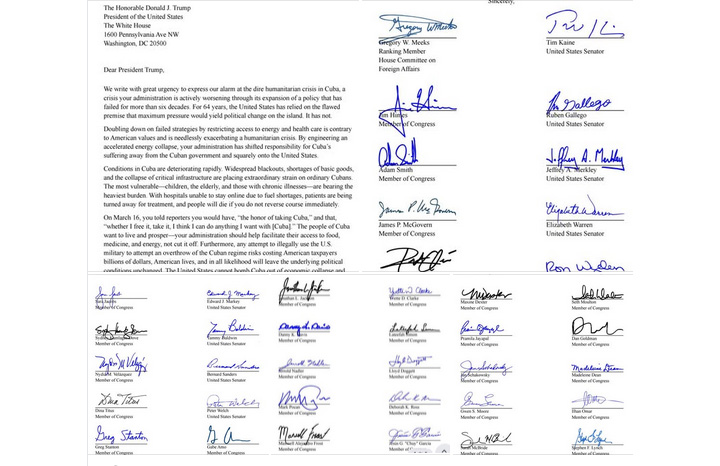
Fifty members of the U.S. Congress—senators and representatives from both parties—have sent a strong signal of dissent over Washington’s hardline approach to Cuba. In a letter addressed to President Donald Trump, they condemned the long‑standing U.S. economic, commercial, and financial blockade, called it a failed policy, and urged an immediate change of course in American policy toward the island.
The letter, sent from Washington and highlighted by Lianys Torre Rivera, Cuba’s chief representative in the United States, was led by Representative Gregory Meeks, the top Democrat on the House Foreign Affairs Committee, and Senator Tim Kaine, ranking minority member of the Senate Foreign Relations subcommittee for the Western Hemisphere. Their signatures give the message significant political weight, not just symbolic value.
At the heart of the letter is a clear historical and moral argument: measures of pressure against Cuba have existed for more than six decades, and they have not achieved their stated goals. Instead, the lawmakers argue, Washington’s current approach is deepening a humanitarian crisis on the island, particularly in the energy and health sectors. Power outages, shortages of basic goods, and the collapse of critical infrastructure are described as direct consequences of the sanctions, with children, the elderly, and people with chronic illnesses paying the heaviest price.
The signatories stress that restrictions on fuel and other essential supplies are already affecting the operation of hospitals and putting patients’ lives at risk. In their view, keeping these policies in place and even tightening them runs counter to the values the United States claims to defend. The legislators warn that by accelerating an energy collapse in Cuba, the administration is effectively making the U.S. government responsible for a large part of the island’s suffering.
The letter also takes a firm stance against any illegal use of the U.S. military to force regime change in Havana. The lawmakers explicitly reject the idea that sending troops or launching a military operation would improve the situation, arguing that such a move would cost American and Cuban lives without changing the underlying political reality.
Instead, the Congress members insist that the only legitimate way to support the Cuban people is through policies that empower them, not through punitive measures that turn them into instruments of pressure. They point out that Cuba has expressed a willingness to cooperate on issues such as migration and drug trafficking, suggesting that engagement—not confrontation—is the more realistic path forward.
Finally, the signatories call for a fundamental review of the sanctions regime, which they characterize as outdated and draconian. They offer their own cooperation, signaling a desire to work with the administration to design a more sensible, effective, and humane policy. For now, their message is clear: continuing the same failing strategy while people in Cuba struggle to turn on the lights or get medicine is no longer acceptable.