

By Marcel Moreau
Senior Politics Correspondent, Wide World News
February 23, 2026
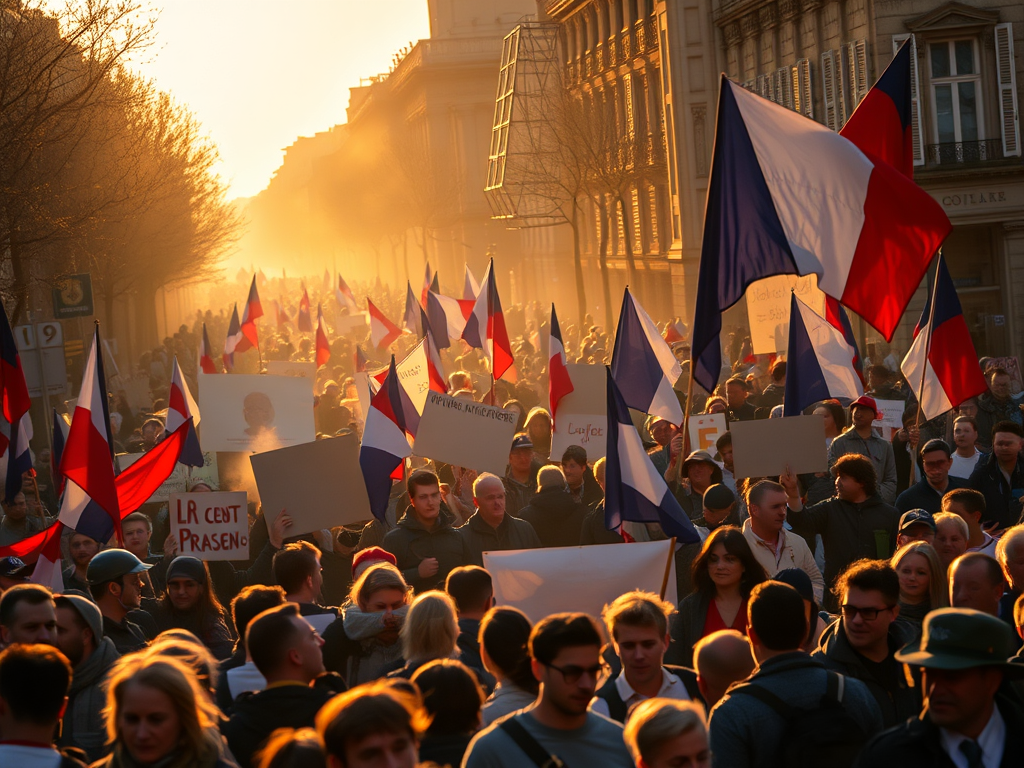
France has long seen itself as the political laboratory of Europe, a place where big ideas clash in the streets before they are codified in law. Over the past few years, the streets have been busy again. Pension reforms, rising living costs, police violence, climate policies and immigration have all sparked large demonstrations. Behind the specific grievances lies a deeper unease: a growing number of French citizens feel that the political system no longer listens to them.
President Emmanuel Macron came to power promising to transcend the old left‑right divide and modernise the country. He positioned himself as a centrist reformer, pro‑European and business‑friendly, willing to take difficult decisions that previous leaders avoided. That vision appealed to urban professionals and parts of the middle class, but it also fuelled a perception among others that he governs for “the elite” and is out of touch with ordinary struggles in smaller towns and rural areas.
As Macron’s political capital has eroded, forces at the extremes have gained ground. On the far right, Marine Le Pen’s National Rally has invested heavily in rebranding, softening some of its rhetoric while maintaining hard lines on immigration, security and national identity. On the far left, Jean‑Luc Mélenchon’s France Unbowed channels anger at inequality, austerity and what it sees as technocratic arrogance from Paris and Brussels. The traditional centre‑left and centre‑right parties, once pillars of the Fifth Republic, have shrunk into shadows of their former selves.
This fragmentation makes governance harder. Macron’s camp has struggled to secure stable majorities in parliament, forcing the government to rely on constitutional tools that allow it to push through important laws without a full vote. Each time this happens, critics denounce a “democratic bypass,” and protesters return to the streets. The institutions technically remain intact, but their legitimacy is increasingly contested by segments of the population who believe decisions are imposed from above.
Social tensions are amplified by a sense of territorial and cultural divide. Residents of major cities experience France as a globally connected, multicultural society with access to services and opportunities. Many in smaller towns, suburbs and rural areas see a different France: factories closed, public transport cut, hospitals understaffed and cultural change arriving faster than any tangible economic benefit. The “yellow vest” movement crystallised this disconnect, but it has not disappeared; it resurfaces in new forms with each crisis.
Europe adds another layer to the political puzzle. France is central to the European Union’s future, yet domestic debates about sovereignty, regulation and budget constraints are sharpening. Critics on both left and right accuse Brussels of imposing rules that limit France’s ability to protect its workers, farmers or industries. Supporters argue that France’s influence depends on a strong EU, especially in a world of great‑power competition. Voters are left to navigate conflicting narratives: Europe as shield, or Europe as constraint.
Looking ahead, local and national elections will test whether France’s political centre can reinvent itself or whether power will swing decisively toward forces that promise rupture. The far right hopes to turn protest into power, presenting itself as a respectable alternative to the “system” while downplaying its more radical roots. The left seeks a new alliance broad enough to challenge both Macron’s camp and nationalist currents, but internal divisions over strategy and rhetoric persist.
For now, France feels stuck between reform fatigue and fear of change. Many recognise that the country needs to adapt—to economic shifts, demographic trends and environmental imperatives—but distrust the actors driving those changes. In such an atmosphere, each policy debate risks becoming a referendum on the entire political class. Whether France can renew trust in its institutions without a severe shock is the central question hanging over its democracy.