

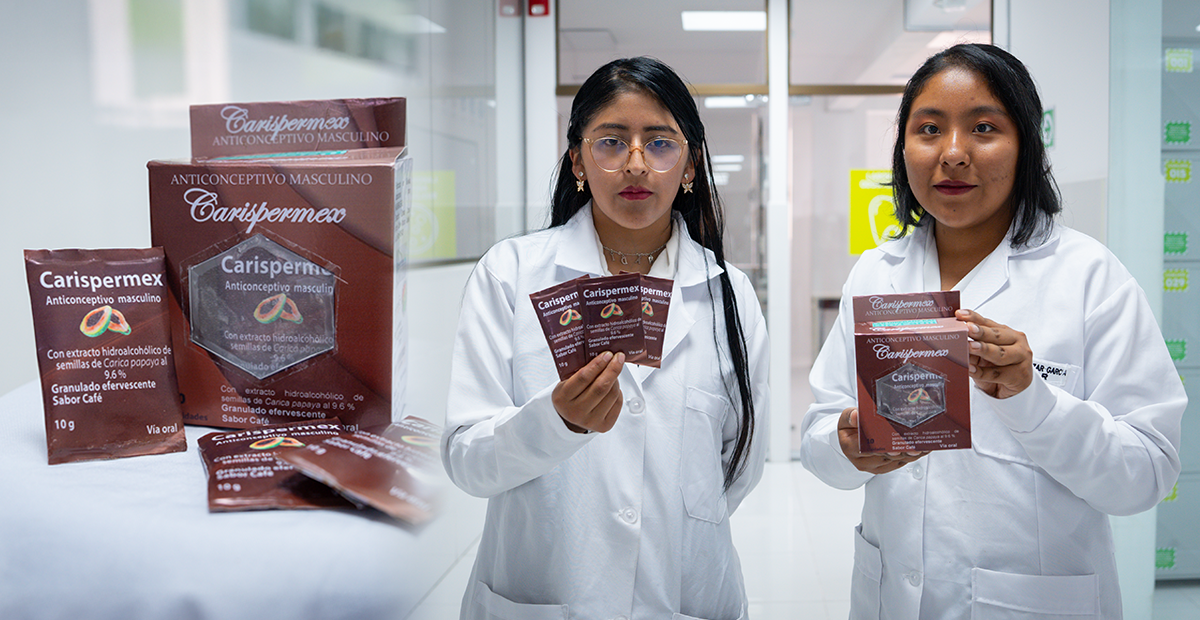
In a world where most contraceptive options are still carried by women, a new student project from Bolivia is offering a possible alternative: Carispermex, a reversible male contraceptive made from papaya seeds (Carica papaya L.). Developed by three Bolivian students at the Universidad Privada Franz Tamayo (Unifranz) in El Alto, this experimental formula aims to reduce male fertility temporarily, without hormones and with the goal of balancing responsibility in family planning.
🔬 What is Carispermex?
Carispermex is a reversible, male contraceptive prototype that comes in the form of an effervescent granulated powder with a coffee‑like flavor. It is taken orally, dissolved in water, and designed to act over a short period while maintaining fertility in the long term. The project is still in the experimental phase, relying on preclinical and animal‑model research, and has not yet been approved by any national or international health authority for human use.
🧪 How does it work?
According to the project’s description, the treatment follows a simple pattern:
- Dose: 20 grams per day
- Duration: 10 days of continuous intake
- Effect: temporary reduction or near‑complete inhibition of sperm production for about one month
- Mechanism: induction of transient azoospermia (a significant decrease or temporary absence of sperm in the semen)
The active ingredients are believed to come from bioactive compounds in papaya seeds, such as carpaine, phenolic compounds, and isothiocyanates, which have shown in animal studies the ability to:
- Reduce sperm count and motility
- Disrupt spermatogenesis (sperm formation)
- Do so reversibly, with full recovery of reproductive function after stopping the compound
Animal trials using different papaya seed extracts have reported reversible inhibition of fertility without permanent hormonal changes or severe toxicity, which is promising—but still not proof of safe or effective use in humans.
🌱 Why papaya seeds?
Carica papaya seeds have long attracted scientific interest for their potential antifertility properties in males. Multiple studies in rodents and other animals have shown that:
- Certain fractions from papaya seeds can cause azoospermia or strong oligospermia.
- These effects are reversible once the treatment is stopped and fertility returns over weeks.
- Sperm motility and viability drop significantly.
- Testosterone and libido remain largely unaffected.
- No major organ toxicity has been detected in those models under controlled dosing.
Carispermex takes this existing evidence and adapts it to a practical format for possible human use: an easy‑to‑consume, pleasant‑tasting effervescent that could, in theory, let men use contraception for a month without surgery, implants, or hormone injections.
📊 What is the evidence so far?
So far, the project relies on preclinical data and animal‑model studies, not human clinical trials:
- Laboratory and animal work supports the idea of safe, dose‑dependent, reversible antifertility effects using papaya‑seed extracts.
- These studies show recovery of sperm quality and testicular histology after withdrawal, suggesting the method is not permanently sterilizing.
- Effects on libido or sexual behavior appear minimal in the tested models.
However, no clinical trials in humans have been completed for Carispermex itself. That means:
- Its efficacy and safety in people are still unknown.
- Side effects, interactions with other drugs, infertility duration, and long‑term impact on the testes or liver must still be rigorously evaluated.
- It is an experimental concept with potential, not an officially approved contraceptive.
🎯 Why is Carispermex innovative?
Carispermex stands out because it responds to a long‑standing gap in reproductive health:
- More options for men: Most widely used reversible methods are hormonal or surgical (vasectomy). This project explores a non‑hormonal, reversible oral option.
- Temporary and reversible: Unlike vasectomy, the goal is short‑term, reversible infertility, with normal fertility returning after the cycle.
- Shared responsibility: It shifts the burden of contraception away from women alone, encouraging equal responsibility in family planning.
- Natural‑based, low‑cost potential: It uses a widely available tropical fruit seed, which could, in the long run, mean a more accessible and sustainable method, especially in regions with strong papaya cultivation.
🧬 How is it made?
The students’ prototype follows a relatively simple process:
- Selection and drying of Carica papaya seeds.
- Grinding and maceration to extract active bioactive compounds.
- Combination with food‑grade bicarbonate and citric acid to create an effervescent reaction.
- Formulation into a soluble granular drink with a coffee‑like flavor to make it easy to take daily.
This formulation is still at the university‑level prototype stage, developed as part of academic and research work, not as a commercial product.
🌍 Social and ethical implications
Beyond science, Carispermex touches on several social and cultural issues:
- It responds to the need for male birth control options in regions where women bear almost all the contraceptive burden.
- It could reduce the dependence on hormonal methods for women, which can carry side effects.
- It opens space for shared decision‑making in relationships around planning, timing, and frequency of children.
- It also highlights how scientific innovation can emerge from Southern countries, especially in fields like public health, reproductive rights, and sustainable medicine.
🧭 What needs to happen next?
For Carispermex or any similar papaya‑seed based male contraceptive to move from a university project to real‑world use, it must pass through several critical steps:
- Clinical trials in human volunteers, including Phase I (safety), Phase II (dosage and early efficacy), and Phase III (larger‑scale effectiveness).
- Long‑term safety evaluation, including effects on liver, cardiovascular system, and reproductive organs.
- Exact optimal dosing and duration, tailored to humans of different ages and weights.
- Regulatory approval by health authorities, such as local ministries of health and (depending on the market) international bodies.
- Ethical and sociocultural studies to understand how men and couples would accept, adopt, and rely on a method like this.
Until those steps happen, Carispermex remains a promising and inspiring proof of concept: a student innovation that could one day help rebalance who carries the weight of contraception—but not yet a recommended or approved contraceptive method.