


Advertisement

Patagonia’s Tiny Dino Marvel: “Slender Legs” – The Chicken-Sized Hunter That Darted Ancient Dunes 95 Million Years Ago

Patagonia's Tiny Dino Marvel Slender Legs – The Chicken-Sized Hunter That Darted Ancient Dunes 95 Million Years Ago Paleontologists have unearthed in Argentina's Patagonia one of the world's smallest dinosaurs, Alnashetri cerropoliciensis—nicknamed Slender Legs in the indigenous Tehuelche language—a crow-sized predator resembling a roadrunner that scurried across Cretaceous dunes chasing lizards and small mammals. This remarkably preserved specimen, detailed in a February 2026 Nature study, challenges assumptions about miniature dinosaur evolution and highlights the vast biodiversity amid the era's giants. A Miniature Marvel in Giant Country Patagonia is renowned for colossal dinosaurs like Patagotitan mayorum, potentially the largest land animal ever at 40 meters long and weighing as much as 14 African elephants. Yet in La Buitrera—a 30-kilometer stretch of vibrant orange sandstones from the mid-Cretaceous Kokorkom desert, 100 million years old—fossils reveal a miniaturized world preserved amid volcanic silica from the rising Andes. Discovered in Río Negro province near Cerro Policía, Alnashetri measured just 70 cm long (mostly tail), weighed about 1 kg (less than a broiler chicken), and stood crow-height. It ranks among the tiniest dinosaurs globally, comparable to China's Anchiornis or Germany's Archaeopteryx. The first partial leg bones surfaced in 2004, but a 2014 find—a fully articulated adult female skeleton including skull, toe phalanges, and tail vertebrae—unlocked its secrets. At 4 years old upon death, it was rapidly buried by advancing dunes, preserving it nearly intact for 95 million years. Feathered Hunter with Surprising Features Alnashetri belongs to the alvarezsaurid family—small-to-medium theropods ranging from South America to Asia, once mistakenly linked to early birds but actually cousins to Jurassic Park's compsognathids. Unlike typical kin, its forelimbs were surprisingly long with three well-developed fingers, though too small for flight. These mini-wings might have stabilized jumps or served no purpose—nature doesn't require utility for every trait, notes paleontologist Sebastián Apesteguía of Argentina's Félix de Azara Natural History Foundation and CONICET. Its teeth were robust and velociraptor-like, larger than relatives', suited for small prey like lizards, snakes, or mammals rather than insects or termites. Prior views held that truly tiny alvarezsaurids had short, robust arms with oversized thumbs, tiny side fingers, and minuscule teeth, evolving alongside anttermite diets. Alnashetri breaks that mold, explains Peter Makovicky of the University of Minnesota Twin Cities. This suggests small body sizes evolved convergently across the group, dispersing from Argentina to Asia before Pangaea's full breakup. Though no soft tissues or feathers fossilized, relatives confirm Alnashetri was likely feathered—possibly with vivid colors for display. It may have elevated its long tail like a coati for courtship, leveraging sharp dinosaurian vision amid flashy crests and sails seen in peers. Thriving Small in the Age of Giants Cretaceous Patagonia teemed with giants isolated teeth and bones nearby attest to carcharodontosaurs like Giganotosaurus and titanosaurs such as Andesaurus or Argentinosaurus. We envision dinosaur landscapes as vast arenas for behemoths, overlooking the vital small and medium players, Apesteguía observes. Alnashetri-sized dinosaurs likely abounded, hunting solo or in packs. This era of southern giants was anything but monolithic—it pulsed with extraordinary diversity. Alnashetri's story reframes Patagonia not as a titan monopoly, but an ecosystem where tiny, agile hunters dodged behemoths amid shifting dunes, underscoring the richness of 95-million-year-old life.


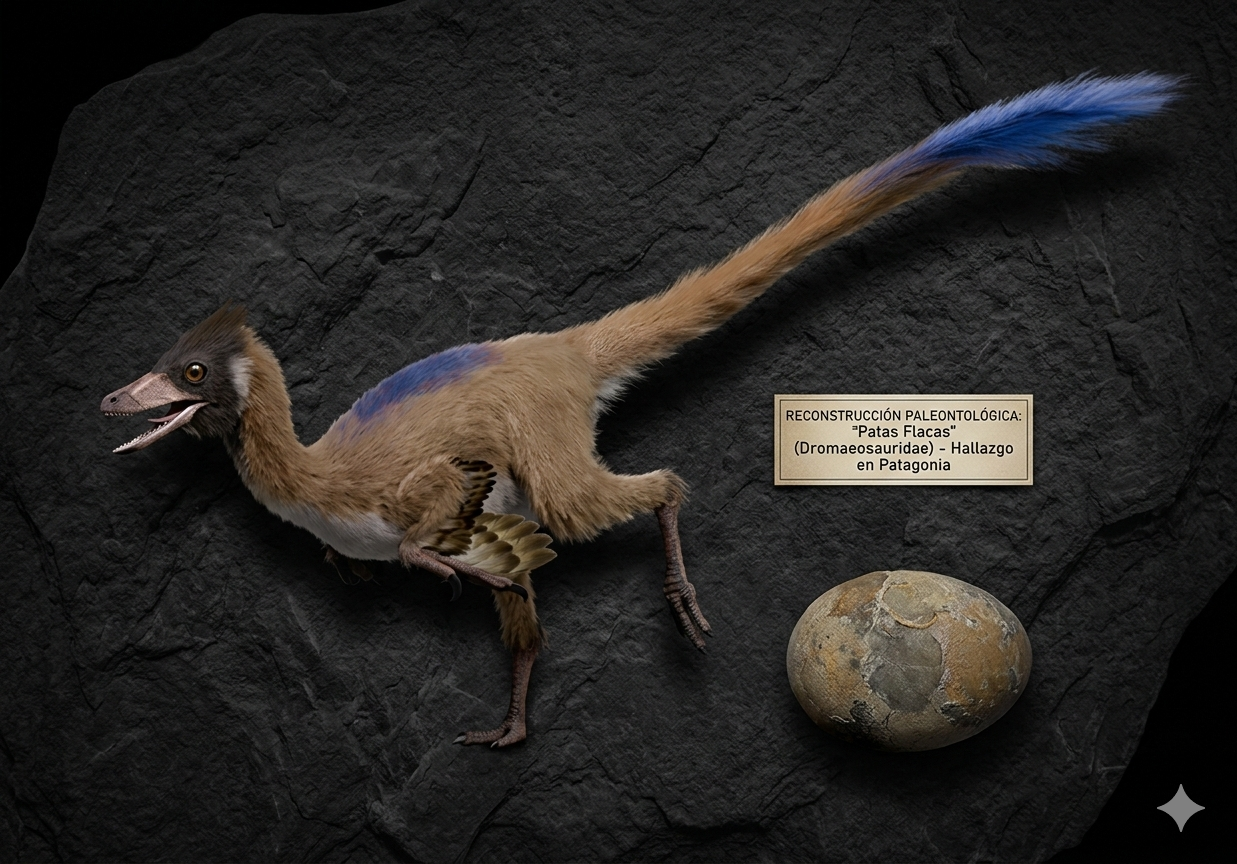
Paleontologists have unearthed in Argentina’s Patagonia one of the world’s smallest dinosaurs, Alnashetri cerropoliciensis—nicknamed “Slender Legs” in the indigenous Tehuelche language—a crow-sized predator resembling a roadrunner that scurried across Cretaceous dunes chasing lizards and small mammals. This remarkably preserved specimen, detailed in a February 2026 Nature study, challenges assumptions about miniature dinosaur evolution and highlights the vast biodiversity amid the era’s giants.

A Miniature Marvel in Giant Country

Patagonia is renowned for colossal dinosaurs like Patagotitan mayorum, potentially the largest land animal ever at 40 meters long and weighing as much as 14 African elephants. Yet in La Buitrera—a 30-kilometer stretch of vibrant orange sandstones from the mid-Cretaceous Kokorkom desert, 100 million years old—fossils reveal a miniaturized world preserved amid volcanic silica from the rising Andes.

Discovered in Río Negro province near Cerro Policía, Alnashetri measured just 70 cm long (mostly tail), weighed about 1 kg (less than a broiler chicken), and stood crow-height. It ranks among the tiniest dinosaurs globally, comparable to China’s Anchiornis or Germany’s Archaeopteryx. The first partial leg bones surfaced in 2004, but a 2014 find—a fully articulated adult female skeleton including skull, toe phalanges, and tail vertebrae—unlocked its secrets. At 4 years old upon death, it was rapidly buried by advancing dunes, preserving it nearly intact for 95 million years.

Feathered Hunter with Surprising Features

Alnashetri belongs to the alvarezsaurid family—small-to-medium theropods ranging from South America to Asia, once mistakenly linked to early birds but actually cousins to Jurassic Park‘s compsognathids. Unlike typical kin, its forelimbs were “surprisingly long” with three well-developed fingers, though too small for flight. “These mini-wings might have stabilized jumps or served no purpose—nature doesn’t require utility for every trait,” notes paleontologist Sebastián Apesteguía of Argentina’s Félix de Azara Natural History Foundation and CONICET.

Its teeth were robust and velociraptor-like, larger than relatives’, suited for small prey like lizards, snakes, or mammals rather than insects or termites. “Prior views held that truly tiny alvarezsaurids had short, robust arms with oversized thumbs, tiny side fingers, and minuscule teeth, evolving alongside ant/termite diets. Alnashetri breaks that mold,” explains Peter Makovicky of the University of Minnesota Twin Cities. This suggests small body sizes evolved convergently across the group, dispersing from Argentina to Asia before Pangaea’s full breakup.

Though no soft tissues or feathers fossilized, relatives confirm Alnashetri was likely feathered—possibly with vivid colors for display. It may have elevated its long tail like a coati for courtship, leveraging sharp dinosaurian vision amid flashy crests and sails seen in peers.

Thriving Small in the Age of Giants

Cretaceous Patagonia teemed with giants: isolated teeth and bones nearby attest to carcharodontosaurs like Giganotosaurus and titanosaurs such as Andesaurus or Argentinosaurus. “We envision dinosaur landscapes as vast arenas for behemoths, overlooking the vital small and medium players,” Apesteguía observes. Alnashetri-sized dinosaurs likely abounded, hunting solo or in packs.

This “era of southern giants” was anything but monolithic—it pulsed with extraordinary diversity. Alnashetri‘s story reframes Patagonia not as a titan monopoly, but an ecosystem where tiny, agile hunters dodged behemoths amid shifting dunes, underscoring the richness of 95-million-year-old life.

Author