

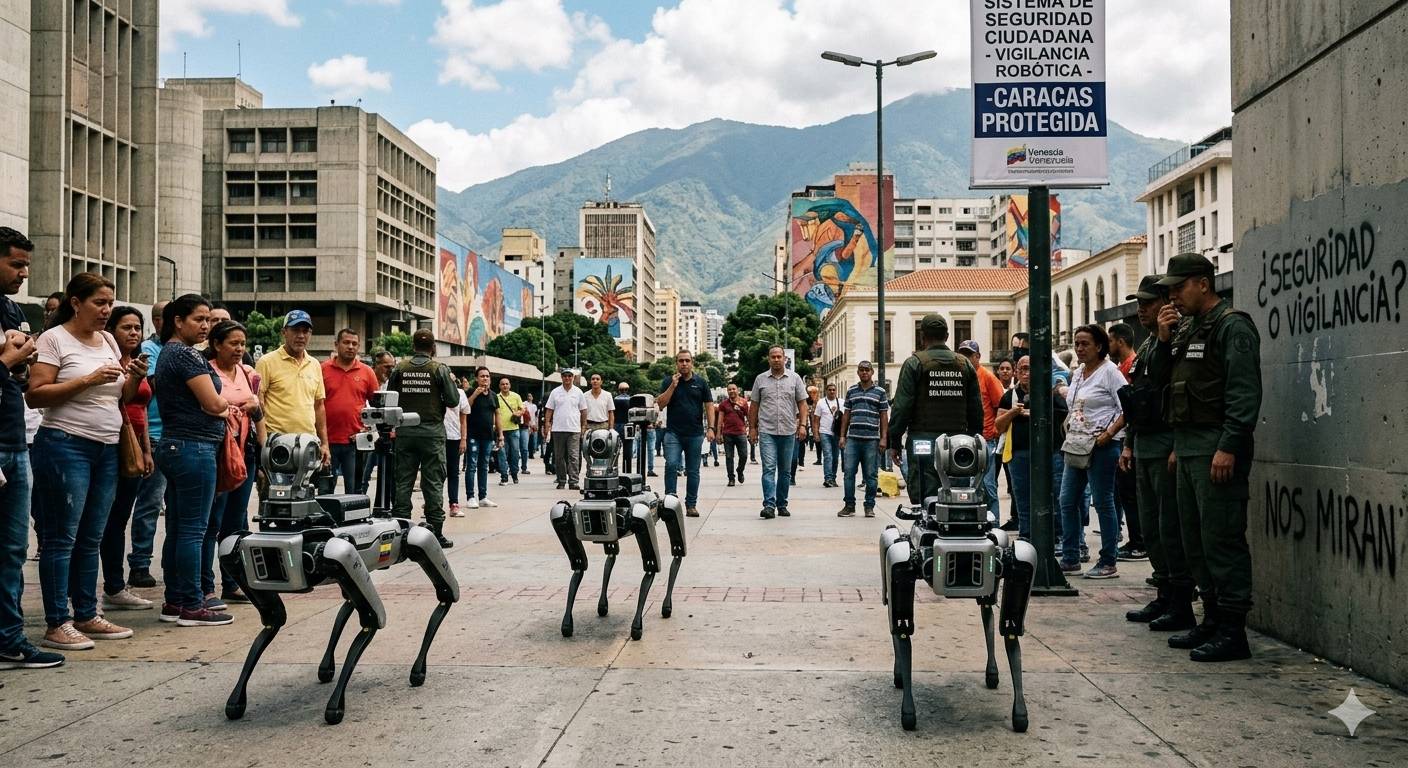
Venezuela has begun using robotic “dogs” in public‑security patrols in Caracas, marking one of the most visible experiments with AI‑driven policing in Latin America. The machines, deployed in the affluent Chacao municipality in eastern Caracas, are designed to patrol parks, plazas, and other public spaces—especially at night—while feeding live video and sensor data back to a municipal command center. Under the name Turbo and Voltio, these two AI‑powered quadruped robots symbolize both a push toward “smart‑city” security and a growing concern about the normalization of surveillance and militarized policing in urban life.
What the robot dogs do
The robotic canines are equipped with high‑resolution cameras, motion‑detection sensors, and license‑plate‑reading capabilities. They are not meant to replace human officers or traditional canine units, but rather to support routine patrols by identifying suspicious movement, tracking vehicles, and transmitting real‑time footage to control rooms where officers can respond faster or dispatch units on the ground. Authorities in Chacao describe the initiative as a pilot program to test how autonomous or semi‑autonomous robots can be integrated into day‑to‑day policing, especially in a district known for its banks, shopping malls, and high‑end hotels.
According to the mayor, the idea is to create a more visible yet “non‑invasive” deterrent, where the presence of the robots signals that public spaces are under constant monitoring. The project is framed as a regional first for Latin America, positioning Chacao as a testing ground for “smart city” policing models that private security firms and tech companies hope to export across the continent.
Security arguments from authorities
Local officials argue that Caracas continues to struggle with high levels of street crime, car theft, and petty violence, which have long eroded public trust in the justice system. By adding robotic units to patrols, they say, police can extend their eyes and ears without significantly increasing manpower, especially during night‑time hours when human visibility is limited. The cameras and motion sensors can help flag unusual behavior—such as people loitering in closed areas, vehicles entering restricted zones, or abandoned objects—before they escalate into more serious incidents.
Moreover, the project is sold as a way to modernize a national security apparatus that has often relied on heavy‑handed tactics and manual patrols with limited oversight. Officials claim that because the robots operate in clearly marked public spaces and transmit data to centralized monitors rather than acting autonomously, they introduce an extra layer of control and accountability, at least in theory.
Growing concerns about surveillance and control
Despite these promises, the deployment of robotic dogs has triggered a sharp debate about privacy, surveillance, and the normalization of militarized policing. Civil‑society groups and digital‑rights advocates warn that 24/7 camera feeds, facial‑recognition‑ready systems, and motion tracking could easily slide from “crime prevention” to systematic social control, especially if the data is later stored, cross‑matched with other databases, or used without clear legal safeguards. In a country with a history of political repression and surveillance of opposition figures, the risk that such technology could be repurposed for monitoring dissidents, protests, or informal communities is particularly acute.
Another concern is the psychological impact of seeing robotic dogs in public spaces. While authorities insist the machines are not armed and are meant to be “friendly,” their appearance and behavior—gliding through streets with cameras scanning faces and license plates—can feel intrusive or intimidating, especially in poorer neighborhoods that may not benefit equally from the technology. Critics argue that the initiative is concentrated in one of Caracas’s wealthiest districts, reinforcing the idea that high‑tech security is first rolled out in areas of economic and political power, while other communities continue to rely on traditional, often abusive, policing practices.
Broader implications for Latin America
The rollout in Chacao is being watched closely by other Latin American governments and security‑tech firms as an early example of how AI‑driven robotics can be integrated into urban policing. If the project is deemed successful and crime statistics improve, it could encourage similar deployments in other capitals, especially those dealing with rising violence and overcrowded prisons. However, it also raises urgent questions about regulation: who oversees the data, under what legal framework can the robots operate, and how can citizens challenge misuse or abuse?
Venezuela’s robotic dogs are a symbol of a wider global trend: the growing use of AI‑enhanced tools in public‑security work, from drones and facial‑recognition cameras to predictive‑policing algorithms. As cities experiment with these technologies, the central challenge will be to balance the promise of safer streets with the need to protect civil liberties, prevent over‑surveillance, and ensure that innovation does not deepen existing inequalities in policing. For Caracas—and for Latin America more broadly—the robots Turbo and Voltio are not just gadgets on patrol; they are key test cases for how technology reshapes the relationship between citizens, the state, and the idea of security in the 21st century.