

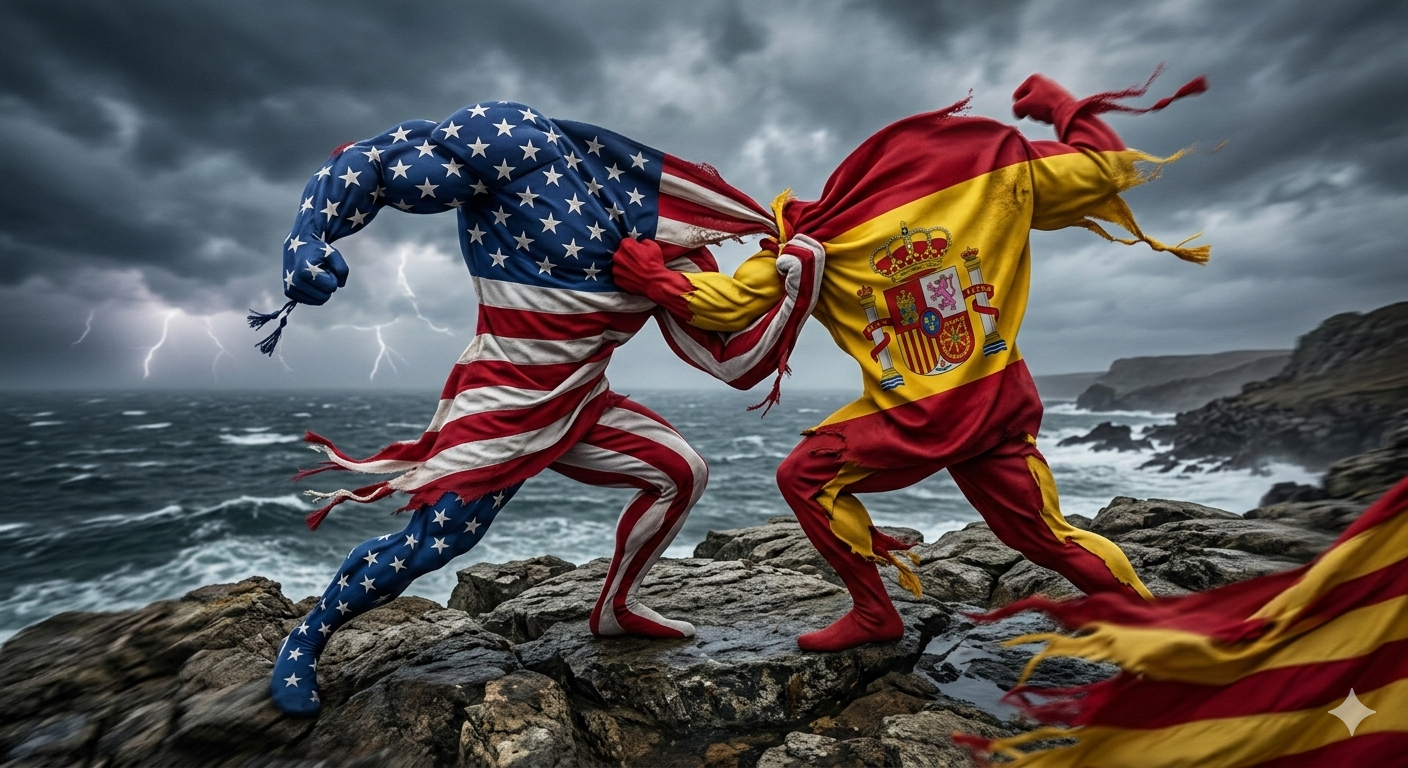
President Donald Trump’s latest outburst against Spain—threatening to sever all trade ties after Madrid denied U.S. access to its military bases for strikes on Iran—marks yet another episode of impulsive foreign policy rhetoric. Speaking from the Oval Office on March 3, 2026, alongside German Chancellor Friedrich Merz, Trump directed Treasury Secretary Scott Bessent to “cut off all dealings with Spain,” labeling the nation a “terrible” NATO ally for resisting a 5% GDP defense spending hike. This follows earlier warnings in October 2025, when Trump floated tariffs over Spain’s NATO spending shortfall. While the bluster grabs headlines, a close look at U.S.-Spain trade data reveals the threat as a boomerang: America exports far more to Spain than it imports, meaning any cutoff would hammer U.S. farmers, energy firms, and manufacturers hardest.
The Spark: Bases, NATO, and Trump’s Grievances
Spain’s decision to block U.S. overflights from bases like Rota and Morón stemmed from constitutional limits on using them for offensive operations without parliamentary approval, amid escalating U.S.-Iran tensions. Trump framed this as betrayal, tying it to longstanding gripes: Spain’s defense spending hovers below NATO’s 2% GDP target, let alone his demanded 5%. “They were the only country that in NATO would not agree to go up to 5%,” he fumed, ignoring that allies like Germany have also lagged historically. Critics see this as Trump’s pattern—using trade as a cudgel for non-economic aims, from NATO burdensharing to base access—echoing his first-term tariffs on Europe.
Yet threats of embargoes or full trade halts carry legal hurdles. U.S. Trade Representative Jamieson Greer noted discussions but hedged, citing Supreme Court-backed presidential powers under national security pretexts. Implementing a total cutoff would require executive orders, potentially sparking WTO challenges or EU retaliation, as Spain is the bloc’s fourth-largest economy.
Trade Reality: U.S. Surplus Exposes the Bluff
Raw numbers dismantle Trump’s bravado. In 2025, the U.S. ran a hefty $4.8 billion goods trade surplus with Spain: exports hit $26.1 billion, dwarfing $21.3 billion in imports. This marks the fourth straight year of U.S. dominance, up from $3.4 billion in 2024. Updated 2024 data aligns, with U.S. goods exports to Spain around $21.8 billion—though services push the total higher—and Spain’s exports at $18.44 billion. Some estimates peg U.S. imports from Spain even lower at $16.72 billion against $29.93 billion exported, widening the gap.
Spain relies heavily on U.S. energy and pharma. Top U.S. exports include petroleum crude oil ($5.76 billion in recent years), liquefied natural gas (LNG, $1.36 billion), and medicaments ($3.7 billion)—vital for Spain’s energy security post-Russia fallout and its pharma sector. Spain imports 35% of its U.S. goods as energy, plus semi-manufactured items like metals. Losing these would sting refineries in Tarragona and Bilbao, but Spain has EU alternatives: Algeria for gas, Norway for oil.
Contrast that with U.S. vulnerability. Spain ships olive oil (world leader), auto parts, steel, chemicals, wine, ceramics, and cosmetics—niche but irreplaceable for American consumers and industries. Machinery ($2.61 billion), electronics ($1.57 billion), and edible oils ($1.30 billion) from Spain feed U.S. shelves and factories. California farmers and Florida ports thrive on Spanish imports; a cutoff spikes olive oil prices 20-30% overnight, hitting grocery chains like Walmart.
Economic Blowback: America Hurts More
Any trade rupture amplifies U.S. pain. Spain accounts for just 1-2% of total U.S. trade, but the surplus means American exporters lose $26+ billion annually—equivalent to 0.1-0.2% GDP drag, per models of similar tariffs. U.S. energy giants like Exxon and Chevron ship billions in crude/LNG; diversion to Asia means lower prices, lost jobs in Texas/Louisiana. Pharma firms (Pfizer, Moderna) export vaccines and drugs; Spain’s hospitals can’t switch suppliers instantly, but U.S. firms face revenue black holes.
Spain fares better. U.S. trade is 5-6% of its exports, cushioned by EU single market (60%+) and diversification to Latin America/Asia. A 10% blanket tariff might shave 0.2% off Spain’s GDP directly, less via indirect chains—but eurozone models predict Spain weathers it four times better than broader EU due to lower exposure. Government plans like the 14.1 billion euro “Commercial Relaunch” fund already prep for U.S. tariffs, eyeing new markets. Retaliation? Spain could slap duties on U.S. whiskey, Harley-Davidsons—echoing 2018 EU moves that cost Trump politically.
Longer-term, Trump’s isolationism backfires. Spain’s bases host 5,000+ U.S. troops; alienating Madrid weakens NATO’s southern flank against Iran migration. Investors flee uncertainty: U.S. stocks dipped 0.5% post-threat, Spanish Ibex held firm. Globally, it signals “America First” as “America Alone,” pushing Europe toward China/Russia energy pacts.
Political Posturing vs. Pragmatism
Trump’s rhetoric rallies his base—polls show 60% of Republicans back tough NATO stances—but risks midterm blowback if prices rise. Spain’s Sánchez government, centrist-left, gains domestically by standing firm on sovereignty, boosting approval amid economic resilience. History favors de-escalation: Trump’s 2018 steel tariffs on EU allies fizzled via deals; expect quiet diplomacy here too.
In sum, this “trade war” threat is asymmetric warfare—U.S. firepower meets Spanish agility. Cutting ties guts American exporters while Spain pivots, underscoring why bluffs rarely become policy. Europe watches warily as Trump’s second term tests alliance limits.