

The new Royal Decree 316/2026 creates an extraordinary path to legal status, challenging Europe’s restrictive immigration orthodoxy from within
In a move that has drawn little attention across the Atlantic but could reshape Southern Europe’s demographic and social landscape, Spain’s Socialist-led government has quietly approved an unprecedented extraordinary regularization of undocumented migrants.
The new Royal Decree 316/2026, enacted on April 14, modifies the country’s Immigration Regulation and opens a legal pathway for what experts estimate to be more than 500,000 people living and working in Spain without proper documentation.
For American readers accustomed to a U.S. immigration system that has not seen comprehensive reform in decades, the Spanish approach may seem startlingly pragmatic — or politically impossible.
What the law does
The decree introduces two new provisions — the twentieth and twenty-first additional provisions — to the existing Immigration Regulation (RD 1155/2024). These create an extraordinary regularization mechanism that bypasses the country’s standard, often gridlocked, immigration procedures.
Unlike the U.S. system, where legal status is frequently tied to family petitions or employer sponsorship with multi-year backlogs, Spain’s model focuses on proven integration: continuous residence, lack of a criminal record, and demonstrated social or labor ties to Spanish territory.
Applicants must provide documentation proving their length of stay — a requirement that legal experts warn will be the single greatest hurdle for a population that often lives in the shadows, without lease agreements, bank accounts, or formal employment records.
A judicial and administrative tightrope
The legal analysis comes from Alfonso Álvarez-Buylla Naharro, a magistrate on the Contentious-Administrative Court No. 5 of the Bilbao Court of First Instance, and Silvia Gutiérrez Vallejo, an immigration attorney with the Bar Association of Bizkaia. Writing in the Revista de Derecho vLex, they dissect the decree’s practical implications with the precision of seasoned litigators.
Their warning is clear: the decree’s success depends entirely on how it is implemented. Spain’s regional immigration offices, already stretched thin, will now face a surge of applications. And without uniform criteria, some applicants may be approved while nearly identical cases are denied — a recipe for litigation.
The authors also flag a critical strategic question: What happens during the processing period? Does filing a petition grant provisional status, or do applicants remain deportable while they wait? The decree is ambiguous, and the courts will likely have to decide.
Europe’s demographic dilemma
Spain’s move cannot be understood without acknowledging the continent’s demographic crisis. With one of the lowest birth rates in the world — 1.19 children per woman, far below the replacement rate of 2.1 — Spain needs immigrants to sustain its economy, fund its pensions, and keep its villages from emptying.
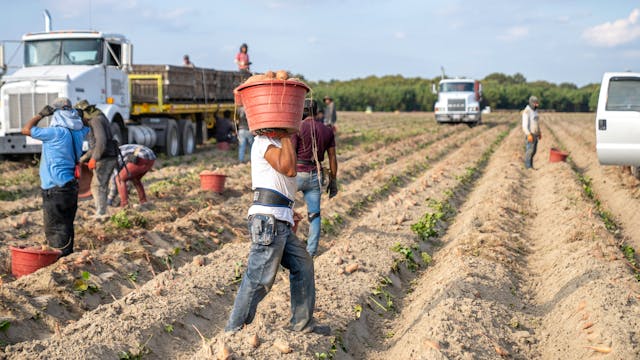
Southern Europe has long relied on undocumented labor for agriculture, construction, hospitality, and domestic work. The new decree simply recognizes reality: these workers are already here, and regularization brings them out of the cash economy, into the tax system, and under labor protections.
How the U.S. might see it
From an American perspective, the Spanish model challenges deeply held assumptions. The U.S. has not passed major immigration reform since 1986, when Ronald Reagan signed a law granting amnesty to nearly three million undocumented immigrants. Since then, political gridlock has produced only enforcement measures, legal limbo for Dreamers, and a border system perpetually in crisis.
Spain is attempting what the U.S. has not dared to try in nearly four decades: a large-scale, administrative-led regularization with no congressional drama, no wall debates, no family separation headlines.
Of course, the comparison has limits. Spain’s undocumented population — roughly half a million to 600,000 people — is a fraction of the estimated 11 million in the United States. Spain is not dealing with a land border crisis in the same way the U.S. faces challenges along the Rio Grande. And Spain operates under a parliamentary system where a governing coalition can push through regulatory changes without the legislative paralysis that characterizes modern American immigration politics.
The pitfalls ahead
Legal scholars are already identifying trouble spots. The decree’s reliance on documentary proof will disadvantage the most vulnerable migrants — those working day labor, sleeping in informal housing, or moving frequently. Without creative evidentiary solutions (witness affidavits, community organization records, or digital breadcrumbs from phones), the regularization could become a bureaucratic obstacle course rather than a genuine pathway.
Moreover, the conservative opposition in Spain has already signaled its intent to challenge the decree. If the People’s Party returns to power, it could attempt to reverse or hollow out the measure, leaving newly regularized migrants in a precarious legal limbo — a cautionary tale for anyone who believes administrative fixes are permanent.
What comes next
For now, Spain’s immigration offices are preparing for a flood of applications. Attorneys like Gutiérrez Vallejo are advising clients to begin gathering any evidence of their time in Spain: receipts, phone records, testimony from neighbors, affidavits from employers.
The coming months will test whether Spain’s bureaucracy can handle the volume, whether the courts will impose uniform standards, and whether Spanish society — which polls consistently show to be more welcoming to immigrants than many of its European neighbors — will embrace the newly legalized or resent them.
For American observers, Spain’s experiment offers a rare real-world case study: Can a Western democracy, facing demographic decline and labor shortages, successfully regularize a large undocumented population through administrative action rather than legislative warfare?
The answer may tell us as much about the future of immigration politics on both sides of the Atlantic as it does about Spain itself.